Published October 14, 2026 · Updated November 1, 2026 · Protocol Archive Editorial
Hip impingement (FAI) exercises: a stage-by-stage home program
Talk to your doctor first. General education, not medical advice.This content is general education, not medical advice, diagnosis or treatment. Get approval from your physician or another qualified healthcare provider before starting any exercise program, especially if you have a medical condition, a recent injury or surgery, are pregnant, or take medication. Stop and seek medical advice if an exercise causes pain, dizziness, chest discomfort or shortness of breath. You choose to exercise at your own risk. Read the full medical disclaimer.
Femoroacetabular impingement (FAI) is when the ball of the thigh bone and the rim of the hip socket meet too early because of their shape. When this causes symptoms it is called FAI syndrome. It usually causes groin pain, which may also be felt in the buttock or outer hip, often with stiffness and pain when sitting, squatting or twisting.
FAI is most common in active young and middle-aged adults, especially in sports that involve repeated deep hip bending. Some people also notice clicking, catching or the hip giving way.
Activity changes and physical therapy are the usual first treatments. Exercise aims to strengthen the muscles that support the hip and improve control, which may reduce stress on the joint.
Stage 1: Calm and control
Settle irritated positions and start building hip and pelvic control without pain.
-
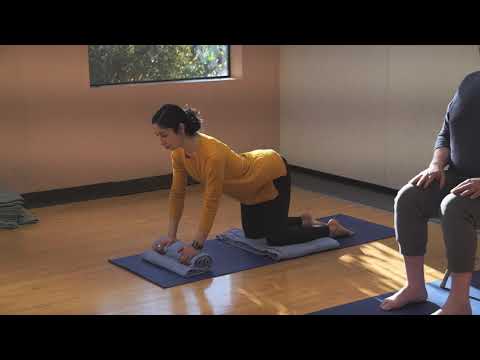
Angry Cat & Cow Spine Mobility
Gently arch and round your back on hands and knees to practice pelvic control.
Typical dose: 10 slow reps1
-
Adductor Squeeze (Ball Squeeze)
Squeeze a ball or cushion between your knees, then relax slowly.
-
Bridge Pose for Glute Activation
Keep your weight even through both feet and lower slowly.
-
Prone Hip Extension
Lie on your front with the knee bent to 90 degrees and lift the leg slightly.
Typical dose: 2–3 sets of 101
-
Clamshells for Glute Medius
Lie with your hips only slightly bent, well short of 90 degrees, to avoid the deep-bend position that often triggers pain.
Typical dose: 2–3 sets of 10
- Changing or avoiding the activities that trigger your symptoms is usually the first step.2,4
- Exercise about 5 days a week with at least 1–2 rest days, resting about 2 minutes between sets.2
- Start with fewer repetitions and build up gradually.1
- Use a higher chair so your hips are not below your knees, avoid sitting cross-legged, and stand up or walk briefly during long periods of sitting.1
- A pillow between your knees at night may help.1
Stage 2: Build strength and balance
Build hip, trunk and leg strength and single-leg control for daily life and sport.
-
Wall Squats for Quadricep Strength
Slide down only part way, ideally no lower than 90 degrees at the hips and knees, with feet a little wider than hip-width.
-
Side Plank Exercise
Start with knees bent and progress to straight legs once easy.
Typical dose: Hold 30–60 sec each side1
-
Single-Leg Bridge
Keep your pelvis level as you lift.
Typical dose: Hold 5 sec; 2–3 sets of 8–122
-
Stand on One Foot Balance Exercise
Hold a support nearby until you feel steady.
Typical dose: Build up to 1 minute on each leg1
- An exercise bike or cross trainer on low resistance is a good way to keep fit. Raise the saddle and sit more upright if cycling is painful.1
- Choose an activity level you can manage regularly (for example 3–5 days a week), keep it for a few weeks, then increase slightly.1
- When returning after a break, increase activity gradually.2
Want this as a checklist? Turn these exercises into a printable home program with videos and daily check-offs. Adjust the list and doses with your clinician.
Printable handout (PDF, 2 pages). Every exercise on this page with a usual starting amount, boxes for your clinician to write your plan, a pain guide and a 6-week tracker.
Download PDF A4 size Large printEn español: PDF · A4
Watch the exercises
Every exercise above links to its own page with a video and step-by-step instructions. Here are two to start with.

What to expect
These are what published guidance usually says. Your own recovery may be faster or slower.
| Question | What sources say |
|---|---|
| How long physical therapy takes | Usually 3–6 months before strength improves and symptoms reduce.1 |
| When to move to Stage 2 | Only when the Stage 1 exercises feel easy and cause no pain.2 |
| Pain during exercise | Mild discomfort that settles within 10–15 minutes is acceptable. Muscle soreness should not disturb your sleep or daily activities.1,2 |
| If it is not improving | If symptoms persist after several months of physical therapy and exercise (often 6–12 months, sooner for some people), talk to your clinician about a specialist referral and other treatments.2 |
What to avoid or change for now
- Repeated deep hip bending that causes pain, such as deep squats, low chairs and long periods of sitting.
- Sitting cross-legged, or squatting deeply with your feet close together.
- Cycling with a low saddle or a leaning-forward position if it hurts.
- Repeatedly stretching into painful positions.
When to get help
- Severe hip pain after a fall or injury, being unable to walk or put weight on your leg, or tingling or loss of feeling in your hip or leg after an injury. Call 911 or go to the emergency department.3
- Severe hip pain that started suddenly without a fall or injury. Get urgent medical advice the same day.3
- A hip that is swollen and feels hot, or skin around the hip that has changed color. Get urgent medical advice the same day.3
- Hip pain with a fever, or feeling hot, cold or shivery and generally unwell (possible joint infection). Get urgent medical advice the same day.3
- Pain that lasts all day after exercise or is severe. Stop the exercise and contact your physical therapist or doctor.2
- Frequent clicking, catching or giving way, which may suggest a labral (cartilage) tear. Ask your clinician to check it.2
For a medical emergency, call 911 (US and Canada), 999 (UK), 000 (Australia) or 112.
Next steps
Related guides: Gluteal tendinopathy, Groin strain, Hamstring strain, or see all conditions.
Need a physical therapist? How to find one in the US or UK, including direct access and checking registration.
More exercises: browse the free exercise library, every one with a video.
Frequently asked questions
Can hip impingement get better without surgery?
Activity changes and physical therapy are the usual first treatments, and many people improve with them. Physical therapy usually takes 3 to 6 months before strength improves and symptoms reduce.
Should I stretch my hip if I have FAI?
Keep your hip moving, but avoid repeatedly stretching into painful positions. Strength and control exercises are the main focus.
Is squatting bad for hip impingement?
Deep squats can trigger pain. Partial squats with your feet a little wider apart, staying above about 90 degrees, are commonly used instead.
Can I keep running or cycling?
If they cause pain, reduce how long or how hard you go and allow more recovery. For cycling, a higher saddle and a more upright position may help.
How do I know if pain during exercise is OK?
Mild discomfort that settles within 10 to 15 minutes is generally acceptable. Stop and get advice if pain is severe or lasts all day.
Sources
- Oxford University Hospitals NHS FT: Femoroacetabular impingement syndrome (FAIS): physiotherapy booklet
- Wiltshire Health and Care (NHS): Femoroacetabular impingement (FAI) syndrome
- NHS: Hip pain in adults
- AAOS OrthoInfo: Femoroacetabular Impingement
Last checked October 2026. Found something out of date? Email hello@protocolarchive.com.
This guide summarizes published hospital, health-service and professional-body advice listed under Sources. It is general information, not medical advice, and does not replace an assessment by your own clinician, whose plan may differ for good reasons. Stop an exercise and get advice if it causes sharp or worsening pain. Protocol Archive is independent and is not affiliated with the NHS, AAOS or any hospital or video publisher named on this page.
Get one exercise a week by email
A short video, simple steps and a free printable routine, every Tuesday. Free, and you can unsubscribe anytime.
We only use your email for this newsletter. Privacy policy