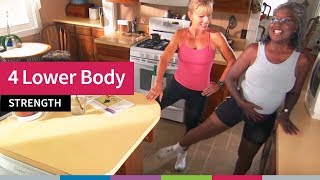
Strength Training Workout for Older Adults
Talk to your doctor first. General education, not medical advice.This content is general education, not medical advice, diagnosis or treatment. Get approval from your physician or another qualified healthcare provider before starting any exercise program, especially if you have a medical condition, a recent injury or surgery, are pregnant, or take medication. Stop and seek medical advice if an exercise causes pain, dizziness, chest discomfort or shortness of breath. You choose to exercise at your own risk. Read the full medical disclaimer.

Free printable PDF
Strength exercises for older adults: printable PDF
A two-page sheet of 12 strength exercises for seniors in 4 phases, from seated moves to resistance bands. Each one has a video. Free, no signup.
Build a full routine
Related routines, each with its own free printable sheet:
Physical therapist or assistant? Add this exercise to a patient’s home program →
Why it helps
Muscle strength falls by roughly a third between the ages of 50 and 80 if nothing is done about it, and strength is what keeps stairs, shopping and getting off the floor possible. The good news is that older muscles respond well to training. This National Institute on Aging workout covers the major muscle groups with chair-supported squats, curls, presses and leg work, and it can be done at home with light weights or household items.
Guidelines recommend strength work on 2 or more days a week for adults over 65. This routine is designed to meet that target.
What the session covers
- Warm-up marching
- Chair squats or sit-to-stands
- Biceps curls and overhead press with light weights
- Wall or counter push-ups
- Knee curls, side leg raises and toe stands with a chair
- Cool-down stretches
Step-by-Step Instructions
- Set a sturdy chair against a wall and have your weights (0.5 to 2 kg to start; cans or water bottles work) within reach.
- Press play and march in place for the warm-up until you feel warmer.
- For each strength exercise, use a 3-second lift, 1-second pause and 3-second lower. Breathe out on the effort.
- Do 10 to 15 reps of each. Rest 30 to 60 seconds between exercises.
- Finish with the stretches, holding each for 10 to 30 seconds.
What you’ll need Paid links
What this exercise uses, with household swaps where they work.
- Light dumbbells · Start light and build up slowly. Water bottles or food cans work to start.
Links go to Amazon search results, so you choose the product and price. We don’t recommend specific brands. As an Amazon Associate we earn from qualifying purchases, at no extra cost to you. How we make money
Key Form Cues
- Breathe out on effort: Exhale as you stand, lift or press; inhale as you lower. Never hold your breath.
- Last two reps should feel hard: If you could easily do 5 more, the weight is too light. If your form breaks before 10, it is too heavy.
- Chair within reach: For every standing exercise, stay close enough to touch the chair.
How much to do
2 to 3 days a week with a rest day between sessions. 1 set to start, building to 2 or 3 sets over a month.
Progression & Regression
Regression (Make It Easier)
- Do all exercises seated and without weights for the first week
- Do 1 set of 8
- Pause the video between exercises
Progression (Make It Harder)
- Increase the weight in small steps when 15 reps feel easy
- Add a second and then a third set
- Add the resistance band upper body workout on alternate days
Who it suits, and who should check first
Good fit for: older adults who want to build or keep strength, people with knee or hip osteoarthritis once the basic exercises are easy, and anyone returning to exercise after a layoff.
Check with your clinician first if: you have heart disease, uncontrolled blood pressure, a recent joint replacement, or osteoporosis with a history of fracture. A quick check with your clinician is sensible before starting a strength program.
Precautions
Designed for older adults; moderate effort with light weights.
- Stop if you get chest pain, unusual breathlessness, dizziness or palpitations, and seek advice before continuing.
- Muscle soreness for a day or two after the first sessions is normal. Joint pain that lasts into the next day is not; reduce the weight or reps.
- Keep the floor clear and wear supportive shoes.
- Stop and consult your provider if: you experience chest pain, faintness, sharp joint pain, or a sudden sharp pain in a muscle.
Frequently asked questions
What weights do I need?
Start with 0.5 to 1 kg per hand, or soup cans and filled water bottles. Many people reach 2 to 4 kg within a few months.
Is it too late to build muscle?
No. Studies of adults in their 70s, 80s and 90s show clear strength gains with regular training.
Where do I start if this is too much?
The 10-minute workout covers the same movements at a lighter level, and the individual exercises are on the strength exercises for older adults sheet.