Prone Hang for Knee Straightening
Talk to your doctor first. General education, not medical advice.This content is general education, not medical advice, diagnosis or treatment. Get approval from your physician or another qualified healthcare provider before starting any exercise program, especially if you have a medical condition, a recent injury or surgery, are pregnant, or take medication. Stop and seek medical advice if an exercise causes pain, dizziness, chest discomfort or shortness of breath. You choose to exercise at your own risk. Read the full medical disclaimer.

Build a full routine
This exercise isn’t on one of our printable sheets yet. These free routines cover similar ground:
Physical therapist or assistant? Add this exercise to a patient’s home program →
Why it helps
A knee that does not straighten fully can cause a limp, extra strain on the thigh, and long-term stiffness. Regaining full extension is one of the early goals after many knee operations, including ACL reconstruction and knee replacement.
The prone hang lets the weight of the lower leg gently ease the knee straight while the muscles relax. It is often paired with the heel prop and quad sets.
Step-by-Step Instructions
- Lie face down on a firm bed, close to the end.
- Slide down so the affected leg is off the edge from just above the kneecap, with a small folded towel under the thigh for comfort.
- Let the lower leg hang straight down and relax the thigh and calf muscles completely.
- Stay in this position for 5 to 10 minutes, breathing normally.
- To finish, bend the knee slowly and slide back onto the bed, then turn over carefully.
Key Form Cues
- Kneecap off the edge: The edge of the bed should be above the kneecap, not under it.
- Let it hang: Relax the muscles and let gravity do the work.
- Stretch, not pain: Expect a stretch behind the knee, not sharp pain.
How much to do
5 to 10 minutes, 2 to 3 times a day, unless your surgical team gives you a different plan. Start with shorter holds if needed.
Progression & Regression
Regression (Make It Easier)
- Hang for 2 to 3 minutes
- Use the heel prop lying on your back instead
- Do quad sets to help straighten the knee actively
Progression (Make It Harder)
- Build up to 10 minutes per session
- Add a light ankle weight only if your surgical team advises it
- Follow each session with terminal knee extensions when cleared
Who it suits, and who should check first
Good fit for: people working on full knee straightening after knee surgery, ACL reconstruction or knee replacement, as part of their surgical team’s program.
Check with your clinician first if: you have had recent knee surgery and your team has not cleared this exercise, you have a graft or repair that limits extension, or you cannot lie face down comfortably.
Precautions
Follow your surgical team’s protocol.
- After knee surgery, only do this when your surgeon or physical therapist includes it in your program.
- A stretch behind the knee is normal; sharp or increasing pain is not.
- Do not add weight unless your surgical team tells you to.
- Stop and consult your provider if: you have sharp or increasing knee pain, new swelling, calf pain, redness or warmth, fever, chest pain or shortness of breath.
Frequently asked questions
Why is getting my knee straight so important after surgery?
A knee that does not straighten fully can make you limp and may stay stiff long term. Your surgical team will usually want full extension early in rehab.
Is the prone hang better than the heel prop?
Both are used to regain knee straightening. Your surgical team or physical therapist will tell you which one suits your surgery; many programs use both. See the heel prop.
Can I do the prone hang after knee replacement?
Some knee replacement programs include it, but follow your surgical team’s plan. See exercises after knee replacement for general guidance.
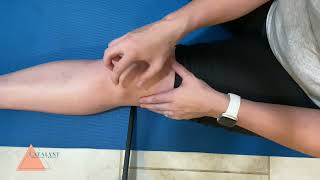
Video: MGHOrthopaedics on YouTube. We link to it because it shows the movement clearly; the written instructions and dosing on this page are our own general guidance.
Try next


Back to Exercise Library
Explore more exercises for every body region, each with a video and step-by-step instructions.