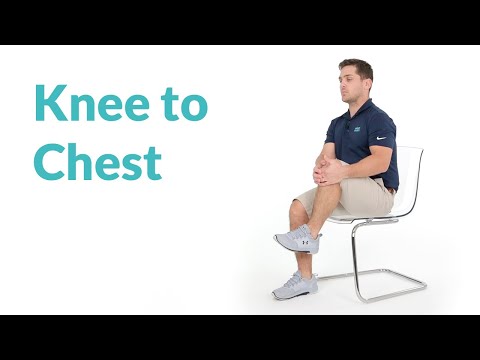
Seated Knee-to-Chest Stretch
Talk to your doctor first. General education, not medical advice.This content is general education, not medical advice, diagnosis or treatment. Get approval from your physician or another qualified healthcare provider before starting any exercise program, especially if you have a medical condition, a recent injury or surgery, are pregnant, or take medication. Stop and seek medical advice if an exercise causes pain, dizziness, chest discomfort or shortness of breath. You choose to exercise at your own risk. Read the full medical disclaimer.
Part of 3 free routines
This exercise is one step in a phased home routine. Follow the whole routine, or print it on one page.
Follow a routine with this exercise, day by day
Degenerative Disc Disease, phase 2Sciatica & Radiculopathy, phase 2Chronic Low Back Pain, phase 2
Opens a free daily checklist with videos and a printable tracker. No sign-up.
Physical therapist or assistant? Add this exercise to a patient’s home program →
Guides that include this exercise
Clinical Context
The seated knee-to-chest stretch is an accessible lumbar flexion exercise that targets the lumbar paraspinal muscles, gluteal muscles, and hip extensors. It is particularly valuable for patients who have difficulty getting down to the floor — the seated version provides the same biomechanical benefits as the supine knee-to-chest while being accessible from any standard chair.
This stretch addresses a common contributor to low back pain: tightness in the posterior chain, including the gluteus maximus, piriformis, and lumbar erector spinae. When these muscles become shortened and hypertonic — often from prolonged sitting or pain-related guarding — they increase compressive loading on the lumbar spine and restrict hip mobility, forcing the lumbar spine to compensate during bending movements.
The knee-to-chest position also gently opens the lumbar intervertebral foramina, which can provide temporary relief for patients with foraminal stenosis or nerve root compression. For this reason, it is commonly prescribed as a self-management technique for patients with sciatica who respond favorably to flexion-based movements (flexion-biased presentation).
Step-by-Step Instructions
- Sit in a sturdy chair with feet flat on the floor and back straight.
- Interlace your fingers around one knee or behind the thigh (behind the thigh is gentler on the knee joint).
- Gently pull the knee toward your chest while sitting tall — avoid rounding your upper back excessively.
- Hold the stretch for 30 seconds while breathing slowly and deeply.
- You should feel a gentle stretch in your low back and the buttock of the pulled leg.
- Slowly release and switch sides.
Key Form Cues
- Sit tall: The stretch is in the hip and low back, not from collapsing your spine forward.
- Pull from behind the thigh: If you have knee issues, clasp behind the thigh rather than over the kneecap.
- Breathe into the stretch: Use each exhale to gently draw the knee a fraction closer.
Progression & Regression
Regression
- Use a towel looped around the thigh to assist if you can’t reach the knee
- Hold for 15 seconds instead of 30
- Don’t pull as far — find a comfortable stretch at about 5/10 intensity
Progression
- Perform the supine version (lying on your back) for a deeper stretch with full body relaxation
- Add both knees to chest simultaneously for a full lumbar flexion stretch
- Combine with a pelvic tilt at the end of the stretch for an active stabilization challenge
- Hold for 60 seconds per side
Precautions
Very safe for most patients. Appropriate for virtually all fitness levels and age groups.
- Patients who respond poorly to lumbar flexion (extension-biased presentations, some disc patients) may find this exercise aggravating — discontinue if it increases radiating symptoms.
- Those with total hip replacements should confirm with their surgeon that this degree of hip flexion is permitted.
- Patients with significant knee arthritis may be more comfortable pulling from behind the thigh.
- Stop if: the stretch increases radiating pain into the leg, which may indicate it’s not the right direction of treatment for your condition.
Related Exercises
Try next


Cleland JA, et al. Examination of a clinical prediction rule to identify patients with neck pain likely to benefit from thoracic spine thrust manipulation and a general cervical range of motion exercise. Phys Ther. 2010;90(9):1239-1250.
Kisner C, Colby LA. Therapeutic Exercise: Foundations and Techniques. 7th ed. F.A. Davis; 2017.
Koes BW, et al. An updated overview of clinical guidelines for the management of non-specific low back pain in primary care. Eur Spine J. 2010;19(12):2075-2094.
Find More Exercises
Browse the full Exercise Archive — 213 exercises with videos, organized by body region, type, and difficulty.