Semont Maneuver for Vertigo (Left Ear)
Talk to your doctor first. General education, not medical advice.This content is general education, not medical advice, diagnosis or treatment. Get approval from your physician or another qualified healthcare provider before starting any exercise program, especially if you have a medical condition, a recent injury or surgery, are pregnant, or take medication. Stop and seek medical advice if an exercise causes pain, dizziness, chest discomfort or shortness of breath. You choose to exercise at your own risk. Read the full medical disclaimer.
Why it helps
BPPV happens when tiny calcium crystals in the inner ear move into a balance canal, causing short spins of vertigo with head movements. The Semont maneuver uses a quick swing to move the crystals back out of the canal.
It is an alternative to the Epley maneuver. Use it only after a clinician has confirmed BPPV and which ear is affected. For leftover dizziness, your clinician may suggest Brandt-Daroff exercises.
Step-by-Step Instructions
- Left ear: sit on the middle of a bed with a helper beside you. Turn your head 45 degrees to the right (away from the left ear).
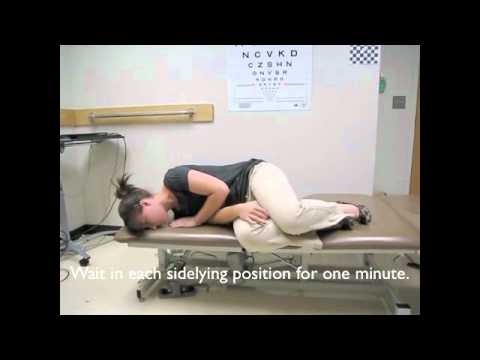
- Keeping your head turned, lie down quickly onto your left side, so you are looking up toward the ceiling. Hold for 1 to 2 minutes, or until the spinning stops.
- In one quick, smooth move, with your helper supporting you, swing up through sitting and down onto your right side, keeping your head turned to the right so your nose now points down toward the bed. Hold for 1 to 2 minutes.
- Slowly sit up and stay seated for a few minutes before standing, with your helper close by.
- Right ear: do the mirror image. Turn your head 45 degrees to the left, lie quickly onto your right side and hold, then swing quickly onto your left side with your nose toward the bed and hold, then sit up slowly.
Key Form Cues
- Head stays turned: Keep the 45-degree head turn through the whole swing.
- Move quickly: The swing from one side to the other should be fast and smooth.
- Expect spinning: Brief vertigo during the moves is common; wait for it to pass.
How much to do
Do it as your clinician directs. It is often done once, and repeated only if your clinician advises it.
Progression & Regression
Regression (Make It Easier)
- Ask your clinician to do the maneuver for you in clinic
- Try the Epley maneuver, which uses slower position changes
- Have two helpers to guide and support the swing
Progression (Make It Harder)
- Follow up with Brandt-Daroff exercises if advised
- Add gaze stabilization for ongoing unsteadiness, if prescribed
- Return to normal head movements and activity as symptoms settle
Who it suits, and who should check first
Good fit for: people with posterior canal BPPV confirmed by a clinician, who know which ear is affected.
Check with your clinician first if: your vertigo has not been diagnosed, you have neck, back or hip problems, heart or blood vessel disease, or you have had a detached retina.
Precautions
Use only for clinician-diagnosed BPPV.
- Have a helper with you, and do it on a bed, not a narrow surface.
- You may feel spinning or nausea during the moves; sit still until it settles before standing.
- Doing the wrong side will not fix the problem; make sure you know which ear is affected.
- Stop and consult your provider if: you have sudden severe headache, double vision, trouble speaking or swallowing, weakness or numbness, face drooping, or cannot walk (call 911); or vertigo that is constant, gets worse, or comes with hearing loss.
Frequently asked questions
Semont or Epley: which is better?
Both are standard treatments for posterior canal BPPV and work well. Your clinician will suggest the one that suits you best.
How do I know which ear is affected?
A clinician finds this with a positional test. Doing the maneuver on the wrong side will not help, so get this checked first.
Is it normal to feel dizzy after the Semont maneuver?
Mild unsteadiness for a day or two is common. Vertigo that gets worse or comes with other new symptoms needs medical review.
Video: Michigan Medicine on YouTube. We link to it because it shows the movement clearly; the written instructions and dosing on this page are our own general guidance.
Try next


Back to Exercise Library
Explore more exercises for every body region, each with a video and step-by-step instructions.
Physical therapist or assistant? Add this exercise to a patient’s home program →