Wrist Range of Motion (Flexion and Extension)
Talk to your doctor first. General education, not medical advice.This content is general education, not medical advice, diagnosis or treatment. Get approval from your physician or another qualified healthcare provider before starting any exercise program, especially if you have a medical condition, a recent injury or surgery, are pregnant, or take medication. Stop and seek medical advice if an exercise causes pain, dizziness, chest discomfort or shortness of breath. You choose to exercise at your own risk. Read the full medical disclaimer.

Build a full routine
This exercise isn’t on one of our printable sheets yet. These free routines cover similar ground:
Physical therapist or assistant? Add this exercise to a patient’s home program →
Guides that include this exercise
Why it helps
After time in a cast, an injury or with arthritis, the wrist can become stiff. Gentle, regular movement helps keep the joint moving and makes daily tasks such as pushing up from a chair or typing easier.
Combine it with tendon glides for the fingers. Once motion improves, gentle stretches for the forearm muscles can help.
Step-by-Step Instructions
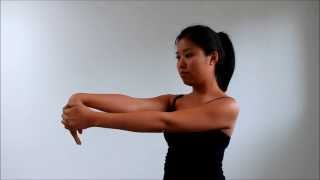
- Sit at a table and rest your forearm on it, palm facing down, with your hand and wrist over the edge.
- Keep your fingers relaxed.
- Slowly bend your wrist up, lifting the back of your hand toward the ceiling (extension). Hold for 2 to 3 seconds.
- Slowly bend your wrist down so your fingers point toward the floor (flexion). Hold for 2 to 3 seconds.
- Repeat, moving only as far as is comfortable. You can also do this with the palm facing up.
Key Form Cues
- Forearm supported: Keep the forearm resting on the table the whole time.
- Relaxed fingers: Do not grip; let the fingers stay soft.
- Gentle end range: Move to a mild stretch, never forced.
How much to do
10 to 15 slow reps, 2 to 3 times a day. Little and often works best for stiffness.
Progression & Regression
Regression (Make It Easier)
- Make the movement smaller
- Warm the wrist first with a warm (not hot) compress
- Do the movement with your hand resting on the table, sliding it gently
Progression (Make It Harder)
- Add gentle stretches: the wrist flexor stretch and wrist extensor stretch
- Add side-to-side wrist movement
- Begin light strengthening such as wrist curls when advised
Who it suits, and who should check first
Good fit for: wrist stiffness after a cast or injury, wrist and hand arthritis, and people who use their hands a lot.
Check with your clinician first if: you have had a recent wrist fracture or surgery (including carpal tunnel release), or have new wrist swelling or numbness.
Precautions
After a fracture or surgery, follow your team’s plan.
- After a wrist fracture, cast removal or hand surgery, follow your surgical team’s or hand therapist’s protocol for when and how far to move. See the carpal tunnel surgery guide.
- Move gently; some stiffness and mild discomfort are normal, sharp pain is not.
- Do not push on the hand to force the wrist further unless your clinician has told you to.
- Stop and consult your provider if: you feel sharp pain, have new or increasing swelling, numbness or tingling, redness or warmth around a wound, or pain is worse the next day.
Frequently asked questions
How do I get my wrist moving after a cast?
Gentle active movements like these are the usual starting point, but follow your clinician’s or hand therapist’s plan for your injury.
Is wrist range of motion good for arthritis?
Gentle daily movement can help with stiffness in wrist arthritis. Move within a comfortable range and avoid forcing.
How often should I do wrist range of motion exercises?
Usually 10 to 15 reps, 2 to 3 times a day. Short, frequent sessions help most with stiffness.
Video: Texas Hand and Wrist on YouTube. We link to it because it shows the movement clearly; the written instructions and dosing on this page are our own general guidance.
Try next


Back to Exercise Library
Explore more exercises for every body region, each with a video and step-by-step instructions.