Heel-to-Toe Balance Walk
Talk to your doctor first. General education, not medical advice.This content is general education, not medical advice, diagnosis or treatment. Get approval from your physician or another qualified healthcare provider before starting any exercise program, especially if you have a medical condition, a recent injury or surgery, are pregnant, or take medication. Stop and seek medical advice if an exercise causes pain, dizziness, chest discomfort or shortness of breath. You choose to exercise at your own risk. Read the full medical disclaimer.

Part of 3 free routines
This exercise is one step in a phased home routine. Follow the whole routine, or print it on one page.
Follow a routine with this exercise, day by day
Plantar Fasciitis, phase 2Fall Prevention for Seniors, phase 2Hip Osteoarthritis & Bursitis, phase 4
Opens a free daily checklist with videos and a printable tracker. No sign-up.
Physical therapist or assistant? Add this exercise to a patient’s home program →
Guides that include this exercise
Clinical Context
Falls are the leading cause of injury death in adults over 65, and the leading cause of traumatic brain injury across all age groups. Each year, one in four older adults experiences a fall, and the risk increases with age, medication use, and lower extremity weakness. Balance training is a commonly recommended intervention for fall prevention.
The heel-to-toe walk (tandem walking) challenges the vestibular, proprioceptive, and visual systems simultaneously by narrowing the base of support to a single line. This task requires real-time integration of sensory feedback from the inner ear (vestibular), joint position sensors in the ankles and hips (proprioception), and visual spatial processing — the same systems that must work together during everyday activities like walking on uneven surfaces, turning in tight spaces, and navigating obstacles.
Studies suggest that balance training produces neuroplastic adaptations — the brain literally rewires to improve postural control. A 2016 systematic review in the British Medical Journal found that exercise programs incorporating balance challenges reduce fall rates by 23% in community-dwelling older adults, with greater effects when balance training is combined with lower body strengthening.
Step-by-Step Instructions
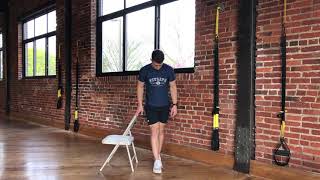
- Stand near a wall or countertop that you can touch for support if needed.
- Focus your gaze on a fixed point at eye level about 10 feet ahead of you.
- Step forward placing the heel of your front foot directly in front of the toes of your back foot, as if walking on a tightrope.
- Walk in a straight line for 20 steps, maintaining heel-to-toe contact with each step.
- Pause at the end, turn around carefully, and walk back.
- Repeat for the prescribed number of sets.
Key Form Cues
- Eyes forward: Looking down at your feet actually impairs balance. Fix your gaze on a point ahead.
- Slow and steady: This is not a speed exercise. Take your time with each step.
- Arms out for balance: Extend your arms to the sides if needed — this is a normal and helpful balance strategy.
Progression & Regression
Regression
- Keep one hand on the wall or counter for support
- Walk with a slightly wider stance (not strictly heel-to-toe)
- Take fewer steps (10 instead of 20)
- Practice on a flat, non-slip surface
Progression
- Perform without wall support
- Walk heel-to-toe with eyes closed (only with a spotter nearby)
- Walk heel-to-toe while turning your head side to side
- Add Tai Chi practice for dynamic balance challenges
- Walk on a slightly uneven surface (grass, folded towel)
Precautions
Safe with appropriate support measures.
- Always practice near a wall, counter, or with a partner nearby the first time.
- Ensure the floor is clear of trip hazards and the surface is non-slip.
- Patients with significant vestibular disorders (vertigo, Meniere’s disease) may experience dizziness — proceed cautiously.
- Remove loose footwear. Bare feet or non-slip shoes are safest.
- Stop if: you feel dizzy or disoriented, or if you cannot maintain your balance even with wall support.
Related Exercises
Try next


Sherrington C, et al. Exercise for preventing falls in older people living in the community. Cochrane Database Syst Rev. 2019;(1):CD012424.
Gillespie LD, et al. Interventions for preventing falls in older people living in the community. Cochrane Database Syst Rev. 2012;(9):CD007146.
NIA. Balance Exercises for Older Adults. National Institute on Aging, NIH. 2021.
Find More Exercises
Browse the full Exercise Archive — 213 exercises with videos, organized by body region, type, and difficulty.