Tandem Stance (Heel-to-Toe Balance)
Talk to your doctor first. General education, not medical advice.This content is general education, not medical advice, diagnosis or treatment. Get approval from your physician or another qualified healthcare provider before starting any exercise program, especially if you have a medical condition, a recent injury or surgery, are pregnant, or take medication. Stop and seek medical advice if an exercise causes pain, dizziness, chest discomfort or shortness of breath. You choose to exercise at your own risk. Read the full medical disclaimer.
Build a full routine
This exercise isn’t on one of our printable sheets yet. These free routines cover similar ground:
Physical therapist or assistant? Add this exercise to a patient’s home program →
Guides that include this exercise
Why it helps
Narrowing your base of support makes your balance system work harder: the ankles, hips, eyes and inner ear all have to adjust. Practicing it safely helps you handle narrow spaces, turns and uneven ground.
Balance practice is a core part of fall prevention programs. Once tandem stance is steady, progress to the heel-to-toe walk.
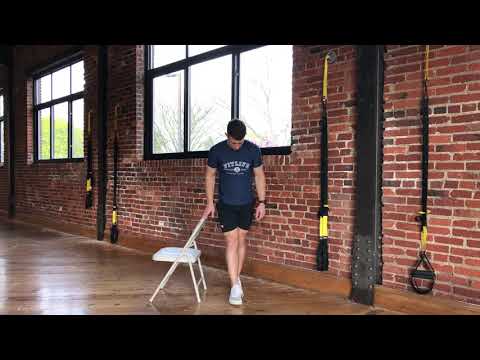
Step-by-Step Instructions
- Stand facing a kitchen counter, close enough to hold it with both hands. Have a chair behind you if you wish.
- Place one foot directly in front of the other so the front heel touches the back toes, in a straight line.
- Stand tall, look straight ahead at a fixed point, and keep your weight even between both feet.
- Hold for 10 to 30 seconds, using the counter as much as you need. Try to loosen your grip as you steady.
- Step out of the position, then switch so the other foot is in front. Repeat.
Key Form Cues
- Eyes ahead: Fix your gaze on a point at eye level, not your feet.
- Stand tall: Keep your chest up and knees soft, not locked.
- Grip as needed: Hold on firmly at first; reduce support only when steady.
How much to do
Hold 10 to 30 seconds, 3 to 5 times with each foot in front, on most days. Short, frequent practice works well.
Progression & Regression
Regression (Make It Easier)
- Place the feet slightly apart (a semi-tandem stance, with the front heel beside the back big toe)
- Hold the counter with both hands the whole time
- Start with weight shifts with feet apart
Progression (Make It Harder)
- Hold with one hand, then fingertips, then hover your hands
- Turn your head slowly side to side while holding
- Move on to the heel-to-toe walk or standing on one foot
Who it suits, and who should check first
Good fit for: older adults, anyone at risk of falls, and people rebuilding balance after illness, surgery or inactivity.
Check with your clinician first if: you have fallen recently, you get dizzy or lightheaded when standing, or you have a condition affecting your balance or feeling in your feet.
Precautions
Always have support within reach.
- Do this at a sturdy counter, never in the middle of a room.
- Wear supportive shoes or go barefoot on a non-slip floor; avoid socks on smooth floors.
- Do not close your eyes unless your clinician has advised it.
- Stop and consult your provider if: you feel dizzy, faint or short of breath, have a near-fall, or notice new weakness, numbness or trouble speaking (call 911 for these).
Frequently asked questions
How long should I be able to hold tandem stance?
Many people work up to 30 seconds with light or no hand support. Progress at your own pace and always stay safe.
Does balance training prevent falls?
Regular balance and strength exercise is a well-established way to lower fall risk in older adults. See the fall prevention guide.
What is the difference between tandem stance and the heel-to-toe walk?
Tandem stance is held still; the heel-to-toe walk adds stepping and is harder.
Video: FitLife Fitness, Aquatics and Physical Therapy on YouTube. We link to it because it shows the movement clearly; the written instructions and dosing on this page are our own general guidance.
Try next


Back to Exercise Library
Explore more exercises for every body region, each with a video and step-by-step instructions.