Published October 14, 2026 · Updated November 1, 2026 · Protocol Archive Editorial
Upper back pain exercises: a stage-by-stage home program
Talk to your doctor first. General education, not medical advice.This content is general education, not medical advice, diagnosis or treatment. Get approval from your physician or another qualified healthcare provider before starting any exercise program, especially if you have a medical condition, a recent injury or surgery, are pregnant, or take medication. Stop and seek medical advice if an exercise causes pain, dizziness, chest discomfort or shortness of breath. You choose to exercise at your own risk. Read the full medical disclaimer.
Upper and mid back (thoracic) pain is felt between the base of the neck and the bottom of the rib cage. It is less common than neck or low back pain. It may start gradually, often with long periods of sitting or slouching, or after a lift, twist, fall or sports movement.
The thoracic spine is strong, and most people improve with simple self-management. Symptoms can last from weeks to months, depending on activity levels, stress, general health and lifestyle.
Staying active and doing gentle movement exercises may help ease stiffness and pain.
Stage 1: Ease stiffness and keep moving
Gently move the mid back through comfortable ranges and stay active.
-
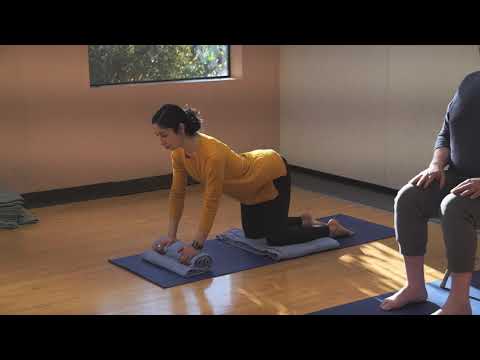
Angry Cat & Cow Spine Mobility
Alternate gently between rounding and arching your back on hands and knees.
Typical dose: 10–20 slow repetitions, 2–3 times a day1
-
Seated Spinal Rotation
Sit tall with your arms across your chest and turn from the mid back, not the low back.
Typical dose: Turn and hold 5 seconds, 5 times each side, 2–3 times a day1,2
-
Endurance Exercise: Walking
Staying active and keeping up your daily activities is better than long periods of bed rest.
Typical dose: Short, regular walks, building up gradually4
Stage 2: Build mobility and posture
Improve upper back rotation and extension and strengthen the muscles between the shoulder blades.
-
Thread the Needle Stretch
Move slowly and with control, and rest 30 seconds between sets.
Typical dose: 10 repetitions each way, 2 sets, 3–4 times a week5
-
Thoracic Spine Mobility Exercises
These NHS movements bend, extend and side-bend the mid back. Stay within a comfortable range.
Typical dose: 10–20 repetitions of each movement, 2–3 times a day1
-
Scapular Squeezes & Posture Correction
Gently draw your shoulder blades back and together without shrugging.
Typical dose: Hold 5 seconds, repeat 5 times, 3 sets, 3–4 times a week5
Want this as a checklist? Turn these exercises into a printable home program with videos and daily check-offs. Adjust the list and doses with your clinician.
Printable handout (PDF, 2 pages). Every exercise on this page with a usual starting amount, boxes for your clinician to write your plan, a pain guide and a 6-week tracker.
Download PDF A4 size Large printEn español: PDF · A4
Watch the exercises
Every exercise above links to its own page with a video and step-by-step instructions. Here are two to start with.

What to expect
These are what published guidance usually says. Your own recovery may be faster or slower.
| Question | What sources say |
|---|---|
| When to see a doctor first | NHS advice is to see a doctor if back pain is coming from the top of your back, between the shoulders, rather than the low back.4 |
| How much discomfort is OK | Discomfort that feels acceptable and eases within about 2 hours of finishing.3,5 |
| When to move to Stage 2 | When the Stage 1 exercises feel easier. Build up gradually.2,3 |
| How long it lasts | Weeks to months. Most people improve with simple self-management.1 |
| If it is not getting better | See a doctor if it does not improve after a few weeks of home treatment.4 |
What to avoid or change for now
- Long periods sitting or standing in one position without a break
- Long periods of bed rest
- Pushing through exercises that clearly increase your symptoms
- Starting exercise before checking the warning signs below
When to get help
- Chest pain, difficulty breathing or unusual breathlessness, or excessive yawning (call 911 for chest pain or trouble breathing)3,4
- Fever, feeling hot, cold or shivery, or feeling generally unwell (get same-day medical advice)3,4
- A history of cancer, or weight loss you cannot explain3,4
- Pain after a serious accident, fall or injury (call 911 or go to the emergency department), or after a minor knock or strenuous lifting if you have osteoporosis3,4
- Constant severe pain that does not change with rest or activity, or pain at night1,3
- Numbness, tingling or weakness in both legs, unsteady walking, a band of pain or numbness around your chest, or changes in bladder, bowel or sexual function (call 911 or go to the emergency department)1,3,4
- A lump or swelling in your back, or your back has changed shape4
For a medical emergency, call 911 (US and Canada), 999 (UK), 000 (Australia) or 112.
Next steps
Related guides: Shoulder impingement, Shoulder instability, or see all conditions.
Need a physical therapist? How to find one in the US or UK, including direct access and checking registration.
More exercises: browse the free exercise library, every one with a video.
Frequently asked questions
What exercises help upper back pain?
Gentle mobility exercises such as cat-cow, seated trunk rotation, thread the needle and side bends, plus shoulder blade squeezes, are commonly used in NHS programs. Staying active also helps.
How long does upper back pain last?
It can last weeks to months. Most people improve with simple self-management such as staying active and doing gentle exercises.
Can posture cause upper back pain?
Long periods of slouched sitting or standing may contribute. Changing position regularly and moving about every 20–30 minutes may help.
When is upper back pain serious?
Get urgent help if it comes with chest pain, breathing problems, weakness or numbness in both legs, bladder or bowel changes, or after a serious injury. Fever, a history of cancer or unexplained weight loss also need prompt medical review.
Should I rest my upper back?
Try to stay active and keep up your daily activities. Long periods of rest can make stiffness worse.
Sources
- Berkshire Healthcare NHS Foundation Trust: Mid back pain (physiotherapy leaflet, 2026)
- Berkshire Healthcare NHS Foundation Trust: Upper thoracic back pain (physiotherapy leaflet)
- NHS Greater Glasgow and Clyde: Self-help and information: upper back
- NHS (nhs.uk): Back pain
- Wrightington, Wigan and Leigh Teaching Hospitals NHS Foundation Trust: Neck and upper back exercises (Level 2)
Last checked October 2026. Found something out of date? Email hello@protocolarchive.com.
This guide summarizes published hospital, health-service and professional-body advice listed under Sources. It is general information, not medical advice, and does not replace an assessment by your own clinician, whose plan may differ for good reasons. Stop an exercise and get advice if it causes sharp or worsening pain. Protocol Archive is independent and is not affiliated with the NHS, AAOS or any hospital or video publisher named on this page.
Get one exercise a week by email
A short video, simple steps and a free printable routine, every Tuesday. Free, and you can unsubscribe anytime.
We only use your email for this newsletter. Privacy policy