Scapular Squeezes & Posture Correction
Talk to your doctor first. General education, not medical advice.This content is general education, not medical advice, diagnosis or treatment. Get approval from your physician or another qualified healthcare provider before starting any exercise program, especially if you have a medical condition, a recent injury or surgery, are pregnant, or take medication. Stop and seek medical advice if an exercise causes pain, dizziness, chest discomfort or shortness of breath. You choose to exercise at your own risk. Read the full medical disclaimer.

Part of 2 free routines
This exercise is one step in a phased home routine. Follow the whole routine, or print it on one page.
Follow a routine with this exercise, day by day
Posture Correction, phase 2Tech Neck & Cervicogenic Headache, phase 3
Opens a free daily checklist with videos and a printable tracker. No sign-up.
Physical therapist or assistant? Add this exercise to a patient’s home program →
Guides that include this exercise
Biceps tendinopathy exercisesShoulder impingement exercisesShoulder instability exercisesUpper back pain exercises
Clinical Context
The scapular squeeze (also called scapular retraction) is a fundamental exercise for strengthening the middle and lower trapezius and rhomboid muscles — the muscles responsible for pulling the shoulder blades back and maintaining upright posture. In patients with chronic neck pain, upper crossed syndrome is one of the most common postural patterns: tight pectorals and upper trapezius combined with weak lower trapezius, rhomboids, and deep cervical flexors.
This exercise directly targets the weak link in upper crossed syndrome. By strengthening the scapular retractors, it counteracts the forward-rolling shoulder posture that accompanies desk work, phone use, and prolonged sitting. When the scapulae sit in a retracted, depressed position, the cervical spine and upper trapezius are unloaded, reducing the mechanical stress that drives cervicogenic headaches and neck pain.
Scapular stabilization exercises are also a key component of shoulder rehabilitation. Studies suggest that scapular dyskinesis — abnormal movement of the shoulder blade — is present in up to 70% of patients with shoulder impingement and rotator cuff pathology. Restoring proper scapular position through retraction exercises creates a stable base for all upper extremity movement.
Step-by-Step Instructions
- Sit or stand with your arms at your sides and shoulders relaxed down away from your ears.
- Imagine squeezing a pencil between your shoulder blades — draw both shoulder blades back and together.
- Hold the retracted position for 5 seconds while keeping your neck and shoulders relaxed.
- Release slowly and repeat.
- Maintain normal breathing throughout — don’t hold your breath during the squeeze.
Key Form Cues
- Retract, don’t elevate: Shoulder blades should move back and slightly down, not up toward your ears.
- Relax the upper traps: If you feel your upper shoulders tensing, you’re compensating — reset and try again with less effort.
- Think “proud chest”: The natural result of good scapular retraction is an open, lifted chest.
Progression & Regression
Regression
- Hold for 2–3 seconds instead of 5
- Perform while lying face-down on a bed to use gravity assistance
- Start with 2 sets of 8 reps
Progression
- Hold for 10 seconds per repetition
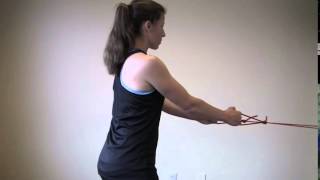
- Add a resistance band — hold the band with arms extended in front and pull apart
- Perform prone Y-raises (lying face down, arms in Y shape, lifting hands toward ceiling)
- Progress to rows with a resistance band or light dumbbells
Precautions
Very safe for virtually all patients.
- Patients with acute shoulder injury should perform gently and within a pain-free range.
- If you have a history of shoulder dislocation, keep the movement controlled and avoid end-range retraction with external rotation.
- Ensure you’re not compensating with lumbar extension (arching the low back) — keep your core gently engaged.
- Stop if: the exercise consistently causes pain in the shoulder joint itself (as opposed to a stretch sensation between the shoulder blades).
Related Exercises
Try next


Cools AM, et al. Rehabilitation of scapular dyskinesis: from the office worker to the elite overhead athlete. Br J Sports Med. 2014;48(8):692-697.
Kibler WB, et al. Clinical implications of scapular dyskinesis in shoulder injury. J Am Acad Orthop Surg. 2013;21(6):364-374.
Sahrmann S. Movement System Impairment Syndromes of the Extremities, Cervical and Thoracic Spines. Mosby; 2010.
Find More Exercises
Browse the full Exercise Archive — 213 exercises with videos, organized by body region, type, and difficulty.