Mini Squat
Talk to your doctor first. General education, not medical advice.This content is general education, not medical advice, diagnosis or treatment. Get approval from your physician or another qualified healthcare provider before starting any exercise program, especially if you have a medical condition, a recent injury or surgery, are pregnant, or take medication. Stop and seek medical advice if an exercise causes pain, dizziness, chest discomfort or shortness of breath. You choose to exercise at your own risk. Read the full medical disclaimer.

Build a full routine
This exercise isn’t on one of our printable sheets yet. These free routines cover similar ground:
Physical therapist or assistant? Add this exercise to a patient’s home program →
Guides that include this exercise
Why it helps
Strong thigh and hip muscles help support the knee joint and make standing up, walking and stairs easier. Keeping the squat shallow lets you build that strength while staying in a range that is usually comfortable for sore knees.
It is a common early exercise in knee arthritis and kneecap pain programs, and a good step toward the sit-to-stand and deeper squats.
Step-by-Step Instructions
- Stand facing a kitchen counter or the back of a sturdy chair, feet about hip-width apart, holding on lightly.
- Keep your chest up and your weight spread evenly through both feet.
- Slowly bend your knees and push your hips back a little, as if starting to sit, going only about a quarter of the way down (30 to 45 degrees of knee bend).
- Pause for a second, keeping your knees in line with your second toes.
- Push through your heels to stand back up tall. Repeat slowly.
Key Form Cues
- Shallow is fine: Stop well before a full squat; a small bend is the whole exercise.
- Knees over toes: Knees point the same way as your feet and do not cave inward.
- Heels down: Keep your heels on the floor the whole time.
How much to do
2 to 3 sets of 10 to 15 slow reps, 3 to 5 times a week. Add reps before you add depth.
Progression & Regression
Regression (Make It Easier)
- Make the bend smaller (just a few inches)
- Hold the counter with both hands and take more weight through your arms
- Start with quad sets or a wall squat with your back supported
Progression (Make It Harder)
- Hold the counter with one hand only, then just fingertips
- Hold the bottom position for 3 to 5 seconds
- Move on to the sit-to-stand or a split squat
Who it suits, and who should check first
Good fit for: knee arthritis, kneecap pain, early knee rehab and anyone who finds getting up from a chair hard.
Check with your clinician first if: you have had recent knee surgery or injury, your knee locks or gives way, or bending the knee causes sharp pain.
Precautions
Keep it shallow and supported.
- Always hold a stable counter or chair; do not use a chair with wheels.
- Mild discomfort (up to 3 out of 10) that settles within 24 hours is acceptable; sharp pain is not.
- If your knee hurts, make the bend smaller rather than pushing through.
- Stop and consult your provider if: you feel sharp or increasing knee pain, the knee swells, locks or gives way, or pain is worse the next day.
Frequently asked questions
How deep should a mini squat be?
About a quarter of the way down, roughly 30 to 45 degrees of knee bend. Go less if that is uncomfortable.
Are mini squats good for knee arthritis?
Strengthening the thigh muscles is a standard part of knee arthritis care, and mini squats are a gentle way to do it. Stay in a comfortable range.
Why does the front of my knee hurt when I squat?
It is often kneecap (patellofemoral) irritation. Make the squat shallower, keep your knees in line with your toes, and see the kneecap pain exercises.
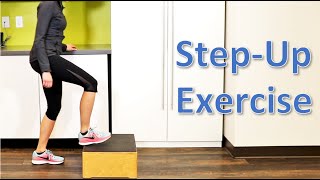
Video: MGHOrthopaedics on YouTube. We link to it because it shows the movement clearly; the written instructions and dosing on this page are our own general guidance.
Try next


Back to Exercise Library
Explore more exercises for every body region, each with a video and step-by-step instructions.