Resistance Band Upper Body Workout
Talk to your doctor first. General education, not medical advice.This content is general education, not medical advice, diagnosis or treatment. Get approval from your physician or another qualified healthcare provider before starting any exercise program, especially if you have a medical condition, a recent injury or surgery, are pregnant, or take medication. Stop and seek medical advice if an exercise causes pain, dizziness, chest discomfort or shortness of breath. You choose to exercise at your own risk. Read the full medical disclaimer.
Free printable PDF
Strength exercises for older adults: printable PDF
A two-page sheet of 12 strength exercises for seniors in 4 phases, from seated moves to resistance bands. Each one has a video. Free, no signup.
Build a full routine
Related routines, each with its own free printable sheet:
Physical therapist or assistant? Add this exercise to a patient’s home program →
Why it helps
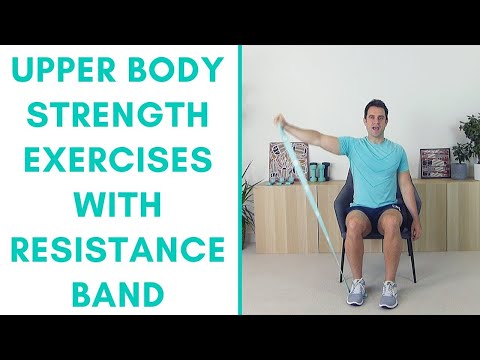
A resistance band is the cheapest, lightest piece of strength equipment there is, and it works the upper body in ways body weight cannot: pulling movements for the back and shoulders that counter rounded posture. This National Institute on Aging workout uses a band for rows, pulls and presses that build the strength you need to lift, carry and reach.
Strength training at least twice a week is recommended for adults over 65, and upper-body work matters for independence: carrying shopping, pushing up from a chair, and holding a rail on the stairs.
What the session covers
- Seated row
- Chest press
- Shoulder (overhead) press
- Front and lateral raises
- Biceps curl and triceps extension
Step-by-Step Instructions
- Choose a light band to start. You should be able to do 10 reps with effort but good form.
- Sit tall in a sturdy chair or stand with feet hip-width apart. Anchor the band under your feet or around a solid post as the video shows.
- For each exercise, pull or press slowly for 3 seconds, pause, and return slowly for 3 seconds. Keep tension on the band the whole time.
- Do 10 to 15 reps of each exercise, rest 30 seconds, and move to the next.
- Finish with the shoulder stretches at the end of the video.
What you’ll need Paid links
What this exercise uses, with household swaps where they work.
- Resistance bands · A set with several levels; start with the lightest. Some clinics give patients a starter band.
Links go to Amazon search results, so you choose the product and price. We don’t recommend specific brands. As an Amazon Associate we earn from qualifying purchases, at no extra cost to you. How we make money
Key Form Cues
- Shoulders down and back: For every pull, think of sliding the shoulder blades down and together. Don’t shrug.
- Control the return: Letting the band snap back wastes half the exercise. The slow return is where strength is built.
- Wrists straight: Keep the wrist in line with the forearm. Bent wrists strain the hand and elbow.
How much to do
2 to 3 days a week with a rest day in between. 1 to 3 sets of 10 to 15 per exercise. Move to the next band color when 15 reps feel easy.
Progression & Regression
Regression (Make It Easier)
- Use the lightest band or fold it to shorten the lever
- Do 1 set of 8
- Skip the overhead press if the shoulder pinches
Progression (Make It Harder)
- Move to a heavier band
- Add a 3-second pause at the end of each pull or press
- Progress to the strength training workout for older adults
Who it suits, and who should check first
Good fit for: older adults building upper-body strength, people with rounded posture or weak shoulders, and anyone who wants a home strength routine without dumbbells.
Check with your clinician first if: you have had shoulder surgery or a dislocation, you get shoulder pinching when lifting the arm, or you have uncontrolled blood pressure.
Precautions
Suitable for most people when a light band is used.
- Check the band for nicks before each use and anchor it securely. A snapping band can injure the face.
- Keep breathing; holding your breath during presses raises blood pressure.
- Mild muscle soreness for a day or two is normal when you start.
- Stop and consult your provider if: you feel sharp or pinching pain in the shoulder, pain or numbness into the hand, or dizziness.
Frequently asked questions
Which band should I buy?
A set of loop or tube bands in two or three resistances. Start with the lightest; most people move up within a few weeks.
Can I do this with shoulder pain?
Often yes, with a light band and movements kept below shoulder height. The NHS shoulder exercises are a gentler starting point if lifting the arm hurts.
How is this different from using weights?
Bands get harder as they stretch, so the end of each movement is loaded most, and they are easier on the joints. Both build strength; bands are cheaper and travel well.