Upper Body Strength for Seniors
Talk to your doctor first. General education, not medical advice.This content is general education, not medical advice, diagnosis or treatment. Get approval from your physician or another qualified healthcare provider before starting any exercise program, especially if you have a medical condition, a recent injury or surgery, are pregnant, or take medication. Stop and seek medical advice if an exercise causes pain, dizziness, chest discomfort or shortness of breath. You choose to exercise at your own risk. Read the full medical disclaimer.
- PositionSeated or standing
- You'll needLight weights optional

Free printable PDF
Strength exercises for older adults: printable PDF
A two-page sheet of 12 strength exercises for seniors in 4 phases, from seated moves to resistance bands. Each one has a video. Free, no signup.
Part of 3 free routines
This exercise is one step in a phased home routine. Follow the whole routine, or print it as a two-page handout.
Follow a routine with this exercise, day by day
Posture Correction, phase 3Fall Prevention for Seniors, phase 3Tech Neck & Cervicogenic Headache, phase 3
Opens a free daily checklist with videos and a printable tracker. No sign-up.
Physical therapist or assistant? Add this exercise to a patient’s home program →
Clinical Context
Age-related muscle loss (sarcopenia) begins as early as the fourth decade and accelerates after age 60, with upper body strength declining even faster than lower body strength in many individuals. The NIA emphasizes that resistance training is a commonly recommended intervention for maintaining independence, preventing falls, and managing chronic conditions in older adults.
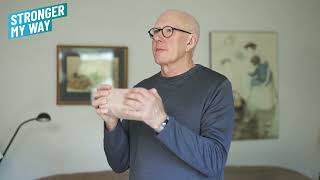
This gentle upper body strengthening routine is designed specifically for older adults, incorporating arm raises, bicep curls, and shoulder exercises using light resistance or no weight at all. The movements target the deltoids, biceps, triceps, and scapular stabilizers — muscles essential for daily activities like reaching overhead, carrying groceries, and getting dressed.
Beyond functional benefits, upper body resistance training has been shown to improve bone mineral density in the spine and forearms (reducing fracture risk), enhance balance through improved neuromuscular coordination, and even improve cognitive function through increased brain-derived neurotrophic factor (BDNF) release during exercise.
Step-by-Step Instructions
- Sit in a sturdy chair or stand near a counter for support.
- Start with no weights or very light weights (1–2 pounds). Water bottles make good starter weights.
- Follow the video instructor through each exercise at the demonstrated pace.
- Perform each movement slowly and with control — 3 seconds up, 3 seconds down.
- Breathe out during the lifting phase, breathe in during the lowering phase.
- Rest for 30–60 seconds between exercises if needed.
What you’ll need Paid links
What this exercise uses, with household swaps where they work.
- Light dumbbells · Start light and build up slowly. Water bottles or food cans work to start.
Links go to Amazon search results, so you choose the product and price. We don’t recommend specific brands. As an Amazon Associate we earn from qualifying purchases, at no extra cost to you. How we make money
Key Form Cues
- Slow and controlled: Never use momentum to swing the weights. If you can’t control the weight, it’s too heavy.
- Full range of motion: Move through the complete range unless pain limits you.
- Stay seated if needed: All exercises can be modified for a seated position.
Progression & Regression
Regression
- Perform all exercises seated
- Use no weight — just the movement pattern
- Reduce repetitions per exercise
- Take longer rest breaks between exercises
Progression
- Increase weight by 1 pound when current weight feels easy for 12+ reps
- Add wrist weights for more continuous resistance
- Perform standing to add a balance challenge
- Increase to 3 sets per exercise
Precautions
Designed for older adults — inherently safe and modifiable.
- Patients with rotator cuff tears or shoulder impingement should avoid overhead pressing motions above shoulder height.
- Those with osteoporosis should use lighter weights and controlled movements to avoid fracture risk.
- If you have uncontrolled hypertension, avoid isometric holds and heavy resistance — keep it light and keep breathing.
- Stop if: you experience chest pain, dizziness, or sharp joint pain during any exercise.
Related Exercises
Try next


Liu CJ, Latham NK. Progressive resistance strength training for improving physical function in older adults. Cochrane Database Syst Rev. 2009;(3):CD002759.
Peterson MD, et al. Resistance exercise for muscular strength in older adults: a meta-analysis. Ageing Res Rev. 2010;9(3):226-237.
NIA. Exercise & Physical Activity: Your Everyday Guide. National Institute on Aging, NIH. 2021.
Find More Exercises
Browse the full Exercise Archive — 213 exercises with videos, organized by body region, type, and difficulty.